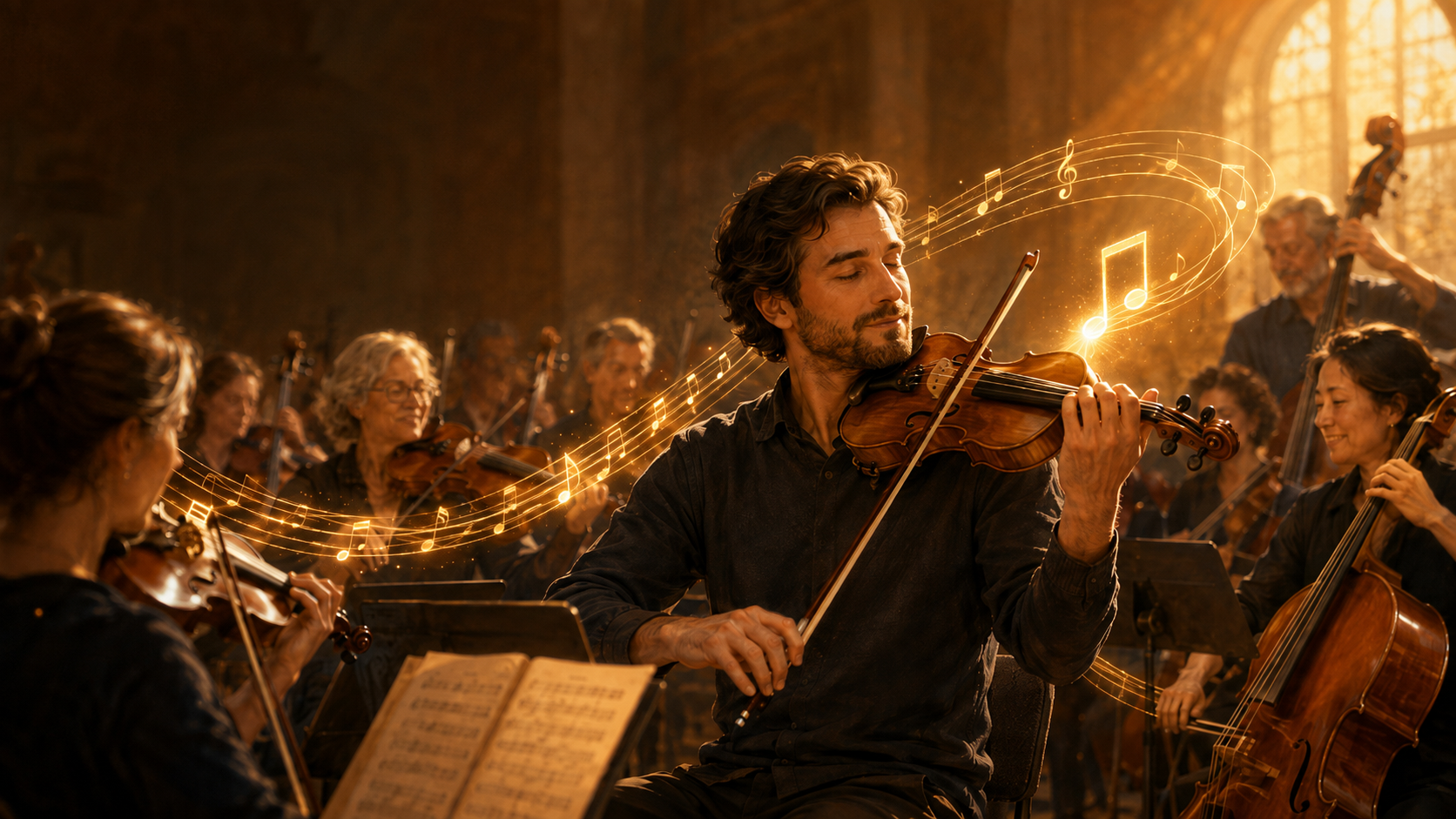
The Note That Was Missing
The Note That Was Missing
Daniel had always been good at fitting in.
As a boy learning violin, he once produced a terrible squeak. A few children laughed, and his teacher said, “Music isn’t about being the loudest. Learn to blend.”
Daniel never forgot those words.
He became a good musician—careful, reliable and always listening. But without realising it, he began doing the same thing in life.
When people asked what he wanted, he often said, “I don’t mind.”
When someone disagreed, he stepped back.
When others had strong ideas about what he should do, believe or become, Daniel listened so carefully that eventually he was no longer sure which thoughts were theirs and which were his own.
Years later, Daniel joined a community orchestra.
One evening they rehearsed a new piece where each section carried a different melody. Halfway through, the conductor stopped.
“Second violins,” she said. “I can’t hear you.”
Daniel explained, “We’re trying not to overpower the main melody.”
She smiled.
“You’re not supposed to overpower it. You’re supposed to answer it.”
Then she looked at Daniel.
“Play your part by yourself.”
He hesitated, then began. The notes were timid.
“Again,” she said. “Play as though your part was written for a reason.”
Daniel looked at the music differently.
His melody was not background sound.
It had something to say.
He played again, this time allowing the notes to be heard.
When he finished, the conductor smiled.
“There you are.”
Daniel laughed. “I’ve been here the whole time.”
“Yes,” she replied. “That’s rather the point.”
Those words followed him home.
Daniel began wondering how often he had silenced himself because he thought kindness meant always giving way.
Perhaps making room for others did not require removing himself from the room.
Not long afterwards, Daniel told his father he wanted to reduce his working week and teach music one day a week.
His father frowned.
“You have a secure job. Why change things now?”
Normally Daniel would have agreed.
Instead, he said, “I know you want the best for me, but I think I need to do this.”
“That doesn’t sound like you.”
Daniel paused.
“It might not sound like the version of me you’re used to,” he said gently. “But I think it sounds like me.”
His father did not agree.
And Daniel realised he did not need him to.
Over the next few weeks, Daniel began noticing how many ideas he carried simply because someone else had handed them to him.
A teacher had made him believe being noticed was dangerous.
Someone had told him he was too sensitive.
Another had laughed at his spiritual beliefs.
So Daniel began asking himself one simple question:
“Does this still belong to me?”
Some things did.
He still valued kindness, listening and respect.
But other things no longer belonged.
Fear of judgement.
The need to be agreed with.
The belief that disagreement meant rejection.
The idea that peace required silence.
Daniel began letting those things go.
Not angrily.
Simply because he had grown.
One evening at rehearsal, Daniel said to the conductor, “I always thought harmony meant everyone agreeing.”
She smiled.
“Imagine an orchestra where everyone played exactly the same note.”
Daniel laughed.
“That would be awful.”
“Exactly. Harmony isn’t sameness. It is listening while still being true to your own part.”
And Daniel realised this was true far beyond music.
We can respect another person’s path without abandoning our own.
We can listen without surrendering ourselves.
We can disagree without becoming enemies.
We can change without condemning our past.
Months later, the orchestra performed before a full audience.
When Daniel’s part arrived, he felt the old instinct to disappear.
Instead, he breathed, listened to the melody around him, and played his own.
Not louder.
Not more important.
Simply present.
And because his note was present, the music became richer.
Perhaps that is what Spirit asks of each of us.
Not to become louder.
Not to become the same.
But to discover what is truly ours, release what no longer belongs to us, and have the courage to offer our authentic self to the world.
The harmony of life was never meant to come from everyone singing the same note.
It becomes beautiful when each of us brings the note that only we can give.
Audio
Your Truth Has a Place in the Greater Harmony
The central lesson flowing through this service is:
Spiritual growth asks us to recognise which beliefs, expectations and attitudes are truly ours, release those that no longer belong to us, and have the courage to live authentically without needing others to think, believe or walk exactly as we do.
This gives the sermon a particularly important distinction.
It is not teaching us to stand in our truth by becoming louder than other people.
It is not saying that because something feels true to us, everyone else must accept it.
And it is not asking us to reject everything we have learned from family, society, religion, culture or experience.
Instead, it asks us to become conscious.
From childhood onwards, we absorb ideas about who we should be, what we should believe, what is acceptable, what will earn approval and what might cause rejection. Some of those teachings serve us well. Others may eventually become masks that cover parts of our authentic selves.
The question raised by the service is therefore a powerful one:
“What am I carrying that no longer belongs to me?”
That question moves the teaching beyond simple confidence.
It asks us to examine ourselves.
Am I reacting from an old fear?
Am I holding a resentment that is shaping how I see today?
Am I still living according to somebody else’s expectation of who I should be?
Am I remaining silent because I genuinely choose peace, or because I am frightened that my truth will not be accepted?
Am I rejecting somebody else’s beliefs simply because they are different from mine?
This is where the sermon’s teaching about attitude becomes important.
We cannot control everything that happens around us. We cannot control what other people think about us, how they respond to our choices, or whether they understand the path we have chosen.
But we can choose how we meet those experiences.
Fear or courage.
Resentment or understanding.
Negativity or hope.
A closed heart or an open mind.
Attitude becomes the place where our spiritual freedom begins.
The wider prayers then expand the lesson beyond the individual. The service acknowledges many cultures, beliefs and spiritual traditions while recognising common values of love, compassion, kindness, peace and hope.
That gives us another part of the teaching:
Standing in our own truth does not require us to diminish someone else’s.
Different paths can still travel beneath the same sky.
Different understandings can still contain wisdom.
Different people can still belong to one human and spiritual family.
The meditation reinforces this through connection with the Earth, nature, Spirit and the quiet place within. It reminds us that underneath the opinions, expectations and pressures of everyday life there is somewhere within us where we can become still enough to hear ourselves again.
The story of the seasons adds the final movement.
Once we recognise something that no longer belongs to us, we must also be willing to release it.
The tree does not argue with the falling leaf.
It does not call itself a failure because one season has ended.
It allows change.
Likewise, an old belief, identity, expectation or attitude may once have had a purpose in our lives and yet no longer be right for the person we are becoming.
Letting it go does not mean condemning the past.
It simply means allowing ourselves to grow.
The distinctive teaching I would draw from the entire service is therefore:
Harmony does not require sameness.
We are each invited to discover the truth within ourselves and have the courage to express it with compassion.
We can listen without surrendering ourselves.
We can disagree without rejecting one another.
We can change without dishonouring where we came from.
We can release beliefs and expectations that no longer serve us without carrying bitterness towards those who gave them to us.
And we can recognise that every person around us is doing the same spiritual work in their own way.
Perhaps our task is not to make everyone sing the same note.
Perhaps our task is to discover the note that belongs to us — and then offer it honestly, lovingly and courageously to the greater song of life.
Core Lesson
Your spiritual truth does not need to compete with another person’s truth in order to have value. Listen within, release what no longer belongs to you, choose the attitude with which you meet life, and have the courage to contribute your own authentic voice. We do not create harmony by becoming the same; we create harmony when each of us learns to stand truthfully within the greater whole.
Audio